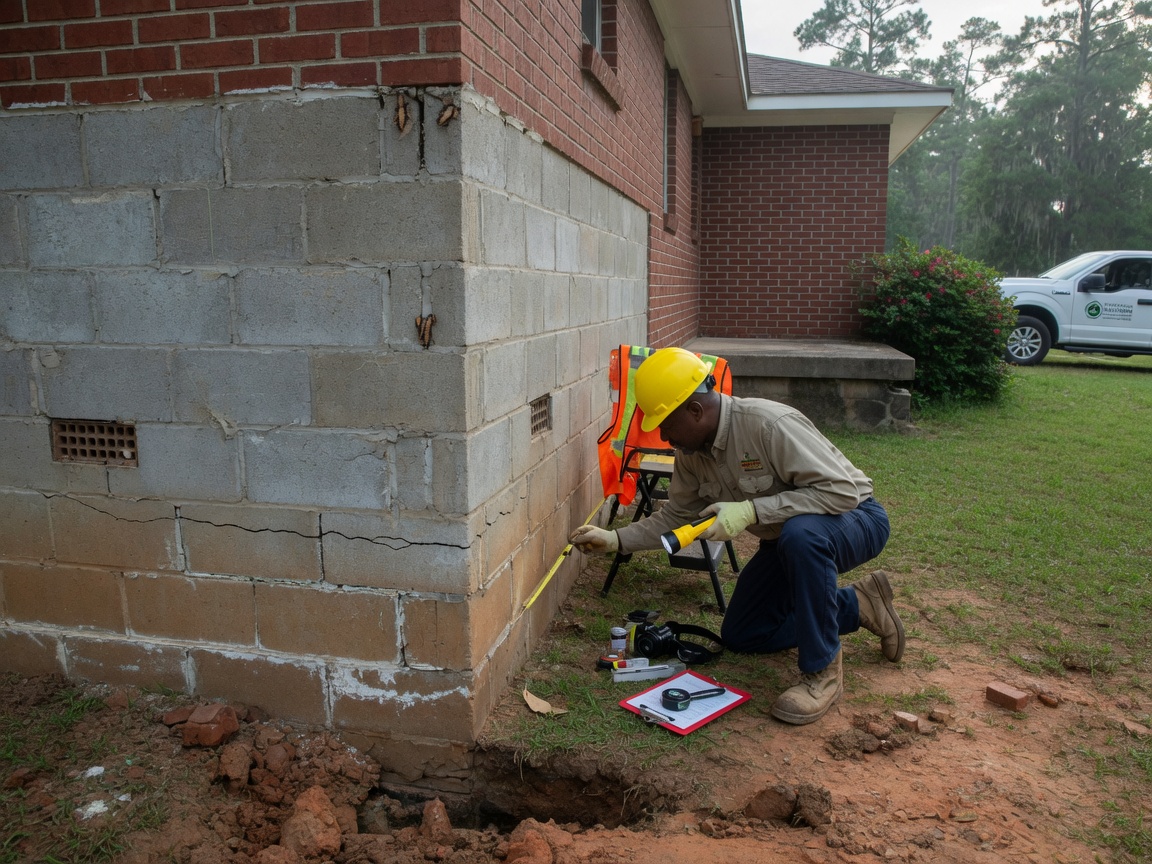
Valdosta sits on clay-heavy soils in Lowndes County that expand and contract with the humid subtropical weather. Hot summers pull moisture out while mild winters and frequent rain push it back in, stressing slabs and pier-and-beam systems common in neighborhoods like Northside, Southside, and Five Points. Older homes near Downtown Valdosta and Park Avenue often rest on shallow footings that were never designed for today’s seasonal swings, so inspectors check for hairline cracks that widen after heavy summer storms.
Crawl spaces under homes in Azalea Park and around Valdosta State University frequently trap humidity that leads to wood rot and mold on sills and joists. Inspectors look for standing water after rains, blocked vents, and soil that has washed away from piers. In newer subdivisions near Freedom Park, post-tension slabs can hide cable corrosion when irrigation systems oversaturate the ground, requiring targeted moisture meter readings and level checks rather than simple visual scans.
Nearby cities such as Tifton, Moultrie, and Thomasville share similar red-clay conditions, so the same inspection protocol applies when clients ask for comparisons. The work focuses on documenting existing cracks with measurements, noting any recent grading changes around Barber Park properties, and flagging drainage paths that direct water toward foundations during the wetter months.
Reports include photos, measurements, and prioritized recommendations that homeowners can hand to contractors. The goal is to separate normal settling from active movement so repairs can be planned before the next heavy rain cycle hits Lowndes County.
Technician insight
In Valdosta the thing that catches most people out with Foundation Inspection is how quickly clay under the slab dries and cracks during a hot July, then swells again after one August thunderstorm; homes in Northside built before 1980 often show this movement first at the garage slab edge because original grading never accounted for today’s heavier rain events.
Southside Home With Garage Slab Shift
The homeowner noticed a widening crack at the garage door after several wet weeks. Inspection found the slab had dropped an inch where downspouts emptied directly onto the clay soil. We documented the grade issue and recommended extending the downspouts and adding a French drain along the side yard. The owner completed the drainage work before the next heavy rain season.
Foundation Inspection Services We Offer
✓Slab Foundation Inspection
Checks post-tension cables, control joints, and moisture levels under concrete slabs typical in newer Valdosta subdivisions.
✓Crawl Space Evaluation
Assesses piers, sills, joists, and ventilation for rot and standing water common in older Northside and Southside homes.
✓Pier and Beam Assessment
Measures pier settlement and beam deflection in homes around Park Avenue and Downtown Valdosta where original footings sit on shifting clay.
✓Foundation Crack Analysis
Documents crack width, direction, and movement patterns after seasonal rains to distinguish cosmetic from structural issues.
✓Moisture Intrusion Check
Uses meters and visual inspection to locate water entry points around grading and downspouts in humid Lowndes County conditions.
Foundation Inspection Cost in Valdosta, GA
| Service | Typical Range | What Affects It |
|---|---|---|
| Standard Slab Home Under 2,000 sq ft | $275–$375 | Includes crawl or slab access; price rises with finished basements or heavy landscaping. |
| Crawl Space Or Pier-And-Beam Home | $325–$450 | Extra time for tight access and wood moisture checks common in older Five Points properties. |
| Add-On Re-Inspection After Repairs | $150–$225 | Covers follow-up measurements once recommended work is complete. |
Ranges are typical for Valdosta, GA and confirmed with an exact written quote before any work starts.
How it works
- 1
Site Walk And Exterior Grading Review
Walk the full perimeter, note soil slope away from the foundation, and check gutters and downspouts for proper drainage in Valdosta’s frequent summer storms.
- 2
Interior And Crawl Space Access
Enter crawl spaces or basements to measure moisture, inspect piers or slab edges, and photograph any visible cracks or wood damage.
- 3
Level And Crack Documentation
Take elevation readings at multiple points and record crack dimensions with photos for later comparison after wet or dry seasons.
- 4
Report With Local Context
Deliver a written report that ties findings to Lowndes County soil behavior and suggests next steps based on the home’s age and neighborhood.
Pricing
Foundation inspections are quoted by square footage and access difficulty; most Valdosta homes fall in a predictable range.